Best Full-Body Workout You Can Do at Home
Gym memberships and expensive equipment aren’t necessary to maintain a regular workout. You can get a good workout for your legs, chest, back, shoulders and core without leaving your living room with a few simple exercises. It all comes down to picking movements that work on other muscle groups and modifying them to your fitness.
A full body workout at home is a great option if you’re a beginner, a busy professional, or if you want to exercise without going to a gym. This book contains a practical workout, exercise modifications and a weekly workout schedule with progression tips to help you train effectively.
What Is a Full-Body Workout?
Full-body workout is a training session that works the major muscle groups of the body as opposed to focusing solely on one particular body part. A balanced program typically consists of:
- Leg exercises: Squats, Lunge and Step Up.
- Exercises for the chest and shoulders: Press-ups and appropriate pressing exercises.
- Back exercises: resistance band rows or other pulling exercises.
- Core exercises: Planks and controlled abdominal exercises.
- Hip exercises: Glute bridges & hip hinge exercises.
You can train multiple muscle groups with these movements in the same workout. These can be done using a variety of exercises, including body weight, resistance bands and dumbbells once strength is able to be added. The ideal routine is one that you can do safely and consistently.
Benefits of a Full-Body Workout at Home
1. Saves time
Exercising without having to go to a gym or wait for equipment. The time for a focused session can vary from about 25 to 40 minutes depending on fitness level, rest periods and number of sets.
2. Requires minimal equipment
There are plenty of exercises that utilize only body weight. Having a stable chair, resistance band or pair of dumbbells can help broaden your playing possibilities, but it’s not necessary to buy all these items first.
3. Trains multiple muscle groups
A well-designed home full body workout involves pushing and pulling, squatting and core-stability movements. This will help you to not focus on the visible muscle parts like arms and chest.
4. Supports general fitness
Frequent resistance training can boost muscle strength and functionality. It can also help with general health and body composition goals, when paired with aerobic exercise and a well-balanced diet.
5. Makes consistency easier
You will also have more flexibility with your training when you do it at home as you have less impact on your work, studies and family obligations. You don’t have to schedule a time when the gym is open to you, you can schedule a time that works for your schedule.
Before You Start: Prepare Your Workout Space
Look for a flat surface that has minimal obstacles and is large enough to stretch your arms and legs. Ensure floor is not slippery, confirm stability of chair or other support. Dress and shoelast comfortable and suitable to your physical activity. Have water on hand and don’t set up equipment where it could trip. After a five minute warm up start.
March on the spot, walk around the room, do some arm circles and do a few easy squats. Your warm up should get you ready for the moves but not make you so tired that you can’t perform them. If you are new to exercise, have a health condition or are coming back after a long period of time, customize the workouts to your level and ask for help if you need it.
The Best Full-Body Workout You Can Do at Home
This is a basic workout with body weight for beginners. Leave 30-40 minutes including warm up and rest.
| Exercise | Main muscles | Sets and repetitions |
| Body-weight squat | Legs and glutes | 2 × 10–12 |
| Incline push-up | Chest, shoulders and triceps | 2 × 8–12 |
| Glute bridge | Glutes and hips | 2 × 12–15 |
| Reverse lunge | Legs and glutes | 2 × 6–8 per side |
| Resistance-band row | Back and arms | 2 × 10–12 |
| Plank | Core | 2 × 15–30 seconds |
| Standing calf raise | Calves | 2 × 12–15 |
Take a brief break (possibly 60-120 seconds or even more if necessary) between sets, while maintaining proper form. If you don’t have a resistance band, don’t just walk away and continue your back training without one, but instead find appropriate equipment or exercise with an alternative that has been safely demonstrated by a professional. One set at first for beginners and gradually increase from there.
1. Body-Weight Squats
Squats are a great way to build leg strength and tone glutes while also practicing a movement pattern that is utilized in daily activities.
How to perform them:
- Step your feet about shoulder distance apart.
- Do not allow your chest to become uncomfortable and your feet to lose their flatness.
- Bend the knees and the hips until you are sitting towards the chair.
- Step down slowly to just as low as you can comfortably step down to.
- Step through to stand back up.
Do not allow knees to fall apart from the feet. Changing from a sitting position to a standing position is more difficult with squats and may be easier to do on a stable chair.
2. Incline Push-Ups
Push-ups work the chest, shoulders and triceps. Incline will make the movement easier than a floor push up.
How to perform them:
- Put your hands on a firm object which will not move.
- Step back with feet, keeping your body straight.
- Draw your chest back towards the surface by tucking your elbows in.
- Drive back to starting position, without dropping hips.
Choose a higher incline if the exercise is too difficult. As you get stronger slowly progress to a lower, stable surface.
3. Glute Bridges
Glute bridges are a great exercise for the glutes and can reinforce hip muscles.
How to perform them:
- Extend your right arm fully, right hand on right hip and fingers pointing downward.
- Do not move your arms away from your sides.
- Tighten your glutes and raise your hips.
- Stop and rest at the top, but not too far into the arch of your lower back.
- Quickly lower hips.
Stop if you are in pain and assess the technique or select a different exercise or modification with assistance.
4. Reverse Lunges
The reverse lunge works out the legs, glutes and balance. Forward lunges may be easier for some beginners than these.
How to perform them:
- Stand up to set position with feet hip-width apart.
- Step one foot backwards.
- Squat, keeping control, as far as is comfortable.
- Move through front foot to stand back up.
- Repeat on other side.
If balance needs to be maintained a wall or stable support should be used. Alternatively, begin with shallow movements or practise supported split squats.
5. Resistance-Band Rows
Rows work the back and arms, and work very well in conjunction with pushing movements in the workout.
How to perform them:
- Follow the instructions on the resistance band and use the appropriate one.
- Fasten it to an anchor that is strong enough to hold it.
- With arms straight, shoulders relaxed.
- Back elbows behind, chest remains still.
- Gradually move back to starting position.
Do not attach a band to an unstable object or use equipment that is damaged. If you have no band, you can purchase one or rent a puller at a gym.
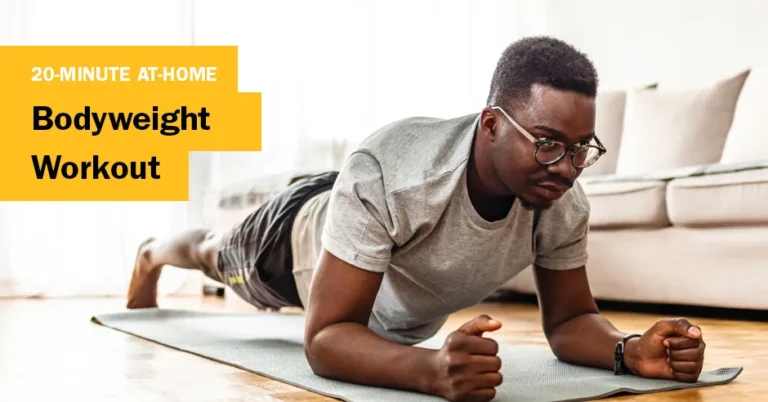
6. Planks
Planks help to engage the core and trunk muscles in supporting the body in a stable position.
How to perform them:
- Rest forearms on floor and raise your arms above your head.
- Straighten your legs to the back.
- Maintain a straight back without drop hips.
- Hold position and breathe normally.
- Halt at the point where you are unable to maintain good form.
It’s an easy plank modification that beginners can do with their knees on the ground. A poorly executed short run hold is more valuable than a long hold with good technique.
7. Standing Calf Raises
Calf raises work the back of the lower leg muscles.
How to perform them:
- Stand feet and knees hip-width apart.
- Stick to the print as tightly as you can.
- Lift heels, keeping balls of feet on floor.
- Pause briefly at the top.
- Slowly lower with heels.
Avoid bouncing. Controlled repetitions allow you to concentrate on the muscle being trained.
How Often Should You Do This Workout?
This is for most beginners the level they achieve when they first start out, full body workout at home twice weekly, on non-consecutive days, is a good condition to start.
| Day | Suggested activity |
| Monday | Full-body home workout |
| Tuesday | Walking or gentle cardio |
| Wednesday | Rest or comfortable movement |
| Thursday | Full-body home workout |
| Friday | Walking or cycling |
| Saturday | Optional recreational activity |
| Sunday | Rest |
The U.S. Centers for Disease Control and Prevention (CDC) suggest doing activities that strengthen the main muscle groups at least two days a week. It can be found at adult physical activity. Give yourself rest periods between intense strength workouts. Avoid pushing it if you are really sore or tired, take a break or decrease the load.
How to Make Your Home Workout More Challenging
To take muscles to their next level of improvement, they require a proper challenge. You don’t need to make each workout more difficult, but you can ramp it up a notch as soon as you start getting comfortable with the workout. Try these methods:
- Do more reps: If appropriate, progress to 8-10 controlled reps
- Include a set: Increase workload from one set to two sets before increasing further.
- Use resistance: Add a suitable resistance band or dumbbell.
- Improve control: Slow down the weight and keep the proper form.
- Try an increased difficulty: For instance, move onto incline push-ups from wall push-ups.
Variations of one factor. If you are not able to keep the technique, go back to the previous easier variation. Progress is dependent on ability and recovery, NOT on a set schedule of events.
Common Mistakes to Avoid
Skipping the warm up: Start for a number of minutes with some easy movement and practise each exercise before use the full working effort.
Hesitating to use good form: Do not sacrifice good form for number of repetitions.
Training upper body only: Add legs, hips, back and core exercises for a full-body workout.
Doing too much, too fast: begin with small numbers of sets and build up gradually.
Quick fixes: Building strength and fitness takes time. Compare and monitor results over the course of weeks rather than the first week only.
Recovery: Balanced meals and rest between challenging sessions, as well as sleep, help to maintain consistent training.
Discontinue exercise if it causes sudden pain, dizziness or other unusual symptoms. If necessary, ask for medical help.
Nutrition Tips to Support Your Workout
It’s not necessary to have a complicated diet while you’re starting a beginner’s workout. Eat a well-balanced diet and eat on a regular schedule.
- Include protein: Eggs, dairy, fish, chicken, beans, lentils and tofu are sources of protein to help maintain and repair muscle.
- Eat carbohydrates: Oats, potatoes, rice, whole grains and fruit all help to provide energy.
- Add vegetables and fruit: They are a source of vitamins, minerals and fibre.
- Water: Drink water, all day, taking into account heat and sweating.
- Rest Adequately: Regular sleep helps to increase recovery and exercise performance.
Nutrition and overall daily activity are also important if you’re looking to lose fat. If your goal is muscle gain, sufficient overall food intake and progressive resistance training are important. There is no guarantee that any one workout will give a workoutter a specific silhouette or speed of change.
Final Thoughts
The best home full body workout is one that trains the major muscle groups, is current to your level of ability and fits with your schedule. Use the 7 exercises in this guide and work on 2 sessions a week at a comfortable pace emphasizing controlled technique.
Once you have become fitter, slowly add more reps, sets or resistance. Strength training, regular walking or other aerobic exercises, good nutrition and adequate recovery. It’s not necessary to have a faultless home gym, just to start. The two most important factors for long term fitness are a safe space and a realistic plan and consistent effort.