Strength Training for Swimmers: Complete Guide to Building Power and Performance
One of the most physically demanding sports in the whole world is swimming. It demands superhuman stamina, skill, elasticity and complete body muscle power per session. Most swimmers do not bother with any land-based strength training and only concentrate on swimming in the pools.
The best way of achieving speed and power in a swimmer is through strength training. Developing more powerful muscles off of the pool directly correlates to improved times and mechanisms. The best competitive swimmers in the world also have well-organized year-long dryland strength programs.
This is the full guide to what the swimmers should know about effective dryland strength training. You will know which muscles are most important, the most effective exercises, and the way to achieve them. This guide will change your swimming performance, regardless of whether you are a competitive or recreational swimmer.
Why Swimmers Need Strength Training
Most swimmers and coaches continue to think that the best way to achieve swimming performance is through pool time only. This old-fashioned perception leaves gigantic performance benefits on the table that have not been touched at all. Studies have always indicated that swimmers who use a combination of pool and dryland training do much better than swimmers.
The strength that is developed in your muscles is what will directly influence the amount of force you produce with each stroke. More power stroke results in higher propulsion in water with less power consumption in general. More powerful swimmers swim more quickly at the same relative intensity as weaker swimmers do.
Strength training: also decreases the risk of swimming injury dramatically with practice. The most common swimming injuries are shoulder impingement, rotator cuff tears, and knee pain. The vulnerable joints can be cushioned by strong supporting muscles, which help to avoid the repetitive stress that high volume swimming causes.
Moreover, training will enhance your body composition by boosting lean muscle mass. A slimmer and more fit body has reduced drag and swims through water more effectively. Every kilo of the excess body fat makes you slow down and consumes your valuable energy production.
Important Swimming Muscles.
Latissimus Dorsi
The major pulling muscles in each of your swimming strokes are your lats. Their catch and pull stroke produces most of the propulsive force. The priority of any strength training for swimmers that swimmers should always have is to develop powerful lats.
Rotator Cuff Muscles
Your shoulder joint is supported by your rotator cuff amid the massive repetitive loading of swimming. The main cause of swimmer shoulder and impingement injuries is due to weak rotator cuff muscles. Rotator cuff strengthening is the most frequent and disabling injury in swimming which can be avoided through targeted strengthening.
Core Muscles
Each stroke cycle moves the force between your upper and lower body by your core. The weak core leads to energy leakage, which retards you, and consumes all muscular effort. Tough core muscles enhance your stance, rotation effectiveness and general stroke strength considerably.
Quadriceps and Glutes
When you swim, your legs provide a lot of kick in freestyle, backstroke, and butterfly kick strokes. A powerful and efficient kick is a result of strong quadriceps and glutes during each training session. Strength in legs can also assist in your position in the body and minimizes drag during your four strokes.
Anterior Deltoids and Chest.
The push of your pull pattern is the muscles of the chest and the front shoulder. The most vigorous movements that they make are butterfly and breaststroke arm movements in each session. The balanced chest and shoulder strength develops to enhance the stroke power and minimize the risk of injuries at the same time.
Workout Strength Training: Swimmers.
Strength training for swimmers should aim at the movements that optimally mimic the swimming movement. Each exercise must build strength on the specific positions and patterns that the water requires. Select exercises that develop functional strength that translates to a better swimming performance, regularly.
Pull Ups and Lat Pull downs.
The most useful strength exercise among both amateurs and professional swimmers is the pull-ups. They directly work your latissimus dorsi, in a motion much like during the pull stage of swimming. Strong pull-up swimmers always produce greater propulsive power per stroke compared to weaker swimmers.
Hang on a bar with hands that are a little more than shoulder length apart. Pull your chest to the bar pushing your elbows down and backwards with force. Reduce gradually to full dead hang and have full control over each repetition. Do 4 rounds of 6-10 rounds with 90 between rounds.
Assisted pull-ups were gradually advanced into full pull-ups to weighted pull-ups over a period of months. Both pull-ups and lat pulldowns build up the pulling force that propels each stroke of a swimmer in a powerful motion.
Rotator Cuff Exercises
The rotator cuff is a component that has to be incorporated in the strength training for swimmers. The exercises that involve rotating externally are meant to work on the infraspinatus and teres minor that are used to protect your shoulder joint. These minute yet important muscles will guard against the impingement of the shoulder that brings many a swimming career to a premature end.
Band External Rotation:
Tie one end of a resistance band to the elbow at the height of the elbow and have the elbow bend at 90 degrees. Keep your arm against your side with the elbow bent and turn your arm outward. A slow control of the return is advised and do 3 sets of 15 per arm then.
Face Pulls:
Create a resistance band by attaching it to the height of your face and, at the same time, pull both hands to your face. Keep your elbows high and wide, squeeze your rear deltoids and rotator cuff. Do 3 sessions of 20 reps with light resistance and emphasize on correct technique at all times.
Deadlifts
Deadlifts develop the back chain muscles required by the swimmer to develop strong kicks. They build up your hamstrings, glutes, lower back and core all in a single motion. Powerful back muscles enhance your position and power of kicks in each stroke.
How to perform:
Place feet at hip width and place a barbell or dumbbells over your mid-foot. Bend at the hips and use hands (outside legs) to hold the bar. Always keep your spine straight and push yourself using your heels to be in an upright position. Reduce the weight gradually to the floor using total control on each repetition. Do 3 rounds of 6 to 8 reps with 90 rest in between each round.
Overhead Press
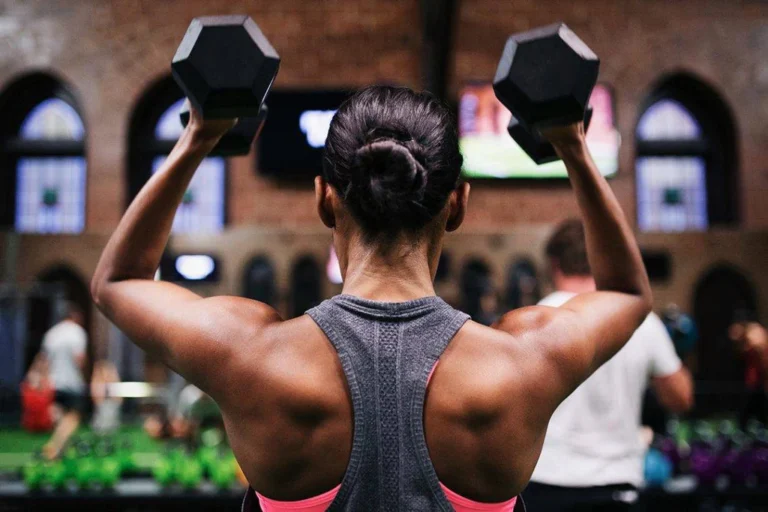
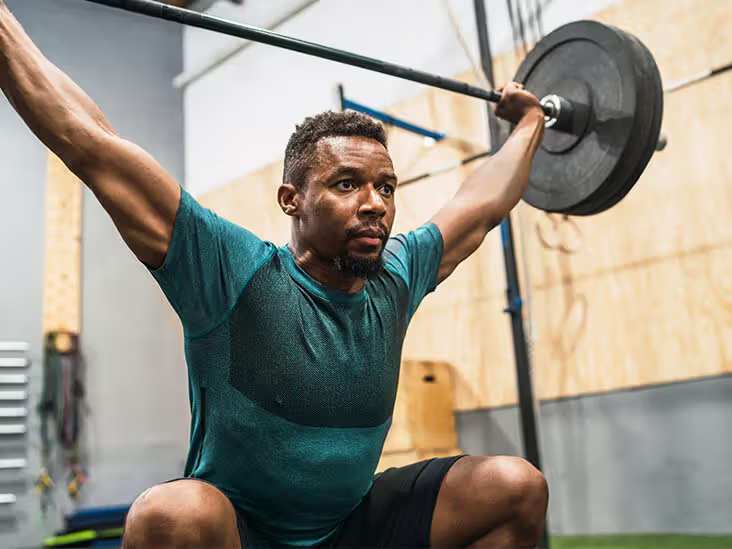
The overhead press improves shoulder stability and strength needed in butterfly and freestyle swimming. It works your anterior deltoids, lateral deltoids, triceps in a vertical pressing motion. The muscles involved in overhead presses are stronger and over time, your stroke entry and catch will get better.
How to perform:
Stand/sit erectly with dumbbells at shoulder level with palms turned forward in a comfortable position. Raise the two dumbbells over your head and make your arms stretch to the full extent. Slow down to shoulder height, and be in full control with each and every movement. Do 3 rounds of 10-12 reps with 60 seconds between sets.
Dumbbell Bent-Over Row
The bent-over row is a fundamental pulling exercise to fully develop the back. It works your lats, rhomboids, and back deltoids in a horizontal pulling motion pattern. This workout is a direct complement of pull-ups and provides balanced back strength to enhance stroke mechanics.
How to perform:
Bend up on your hips until your torso is more or less parallel to the floor. Grasp one dumbbell in each hand and hang straight beneath your shoulders keeping your arms straight. Pull both dumbbells towards your lower ribcage pushing your elbows back through it. Always squeeze the shoulder blades together at the top of each repetition. Do 3 blocks of 10-12 reps with 60 sec rest between each block.
Plank and Core Exercises
Efficient and powerful swimming performance in all strokes cannot be achieved without core strength. A good core keeps your body upright and gives you good transfer of power between your arms and legs. These are some of the most essential exercises that should be included in all strength workouts throughout the year.
Plank Hold:
Be in a forearm plank position with your elbows just under your shoulders in a comfortable position. Have your body straight in a straight line, head to heels. Tighten the core and breathe slowly without trying to bring down your hips. Do 3-45 to 90 second holds with 30 seconds in between sets.
Dead Bug:
Lay on your back with your arms stretched out to the ceiling and knees bent. Lift one arm overhead and at the same time stretch the other leg towards the floor. Go back to the beginning position and do the same on the reverse side under full control. Do 3 series of 10 repetitions on each side and exercise control over all the movements in the same manner.
Squats
Squats strengthen the butt muscles and legs that propel your kick in each swimming stroke. Powerful quadriceps and glutes result in quicker and more efficient kicks with reduced energy consumption. Squats enhance your push-off strength at the wall during races as well, with each turn.
How to perform:
Position with feet at shoulder width, toes turned slightly outwards in a natural shoes position. Bend your hips to the ground until your thighs are parallel with the ground. Push off with your heels and stand up straight, as high as your hips will go. Do 3-4 sets of 10-15 reps with 60 seconds rest between sets.
Medicine Ball Rotating Throws.
Rotational power is fundamental to effective body rotation executing freestyle and backstroke swimming strokes. Medicine ball throws build explosive rotational power that directly enhances your stroke power a lot. This workout builds up your core, hips, and shoulders to move in unison in a rotatory manner.
How to perform:
Stand sideways next to a solid wall holding a medicine ball at hip height. Spin your hips and torso and smash the ball against the wall with your strength. Take the rebound and then swing back to do the second repetition as quickly and explosively as possible. Do 3 rounds of 10 moves on each side with 60 seconds of rest between each round.
Strength Training in Swimmers: example of weekly program.
A properly organized weekly routine will help balance your dryland strength training with what your pool training needs are. Swimmer strength training must not be used as a substitute to swimming activities and must not induce exhaustion in crucial swims. Plan strength sessions in such a way that they help and not disrupt your swimming performance regularly.
In-Season Program (2 Days Per Week)
In the competitive swimming season, restrict the limit strength training to only 2 sessions per week. Such frequency helps to retain the strength that you developed in the off-season without disrupting the pool performance. Make sessions shorter and emphasize on sustaining strength and not constantly developing strength.
Day 1: Full body Upper.
Pull-ups: 3 sets of 6 repetitions.
Bending-over rows: 3 series of 10 reps.
Overhead press: 3 x 10 reps.
External rotation of the band: 3 sets of 15 per arm.
Face pulls: 3 sets with 20 reps each.
Plank hold: 45-second 3 times.
Day 2: Lower Body and Core.
Squats: 3 sets of 12 repetitions.
Deadlifts: 3 steps with 6 repetitions each.
Lunges: 3 rounds of 10 reps each leg.
Dead bug: 3 sets of 10 on each side.
Medicine ball rotational throw: 3 sets of 8 on each side.
Off-Season Program (3-4 days/week)
Your off-season is the easiest time to gain serious strength that will enhance the performance of the next season. Increase the volume and intensity of trains 3 to 4 days per week in this phase. This is where strength training for swimmers brings the greatest performance changes in the long-term.
Day 1: Pull Focus of the upper body.
pull-ups: 4 sets of 6 repetitions (weighted)
Bent-over rows: 4 sets of 8 repetitions.
Face pulls: 3 sets of 20 repetitions.
External rotation of the band: 3 sets of 15 arm repetitions.
Bicep curls: 3 rounds of 12 reps.
Day 2: Lower Body/Core.
Squats: 8 repetitions in 4 sets.
Deadlifts: 4 sets of 6 reps.
Romanian deadlifts: 10 repetitions (3 sets).
Medicine ball rotational throw: 3 sets of 10 on each side.
Plank hold: 3x 60 seconds.
Dead bug: 3 rounds of 10 movements on each side.
Day 3: Upper Body Press Focus.
Overhead press: 4 sets of 8 repetitions
Dumbbell floor press: 3 x 10 reps.
Tricep dips: 3 sets of 12 reps.
Side bends: 3 sets of 15 movements.
Face pulls: 3 x 20 reps.
Day 4: Full Body Power
Jump squats: 5 sets of 4 repeats.
Pull-ups: 8 repetitions x 4 sets.
Deadlifts: 3 rounds of 5 reps.
Slams with medicine ball: 3 sets of 10 repetitions.
What to do to develop your Strength Program in Swimming.
Phase 1: Foundation (Weeks 1 to 4)
Before you begin to add a lot of weight, make sure that you have the proper form on all exercises. The weights used should be moderate and you should be able to achieve perfect technique on each repetition made. This stage develops the quality of movement and stability of the joint which will sustain any further development safely.
Phase 2: Strength Building (Week 5-10)
Gradually add weight to all major exercises at a rate of 2.5 to 5 pounds per week. Minimize repetitions and add weight to develop the greatest strength at this critical stage. This is the most important stage to develop raw power, which enhances swimming performance to a great extent.
Phase 3: Power Development (Weeks 11-14)
Gradually introduce explosive exercises such as jump squats, medicine ball throws, power cleans. Power training takes your new raw strength and turns it into explosive power that propels swimming performance. Shorten rest intervals and speed up movement preserving ideal technique in each set.
Mistakes that Swimmers make when training in strength.
Neglecting Rotator Cuff Work.
Rotator cuff exercises are mostly overlooked by most swimmers since they initially seem to be too simple and insignificant. This can be considered a serious error because of which shoulder impingement occurs and much training time is missed due to an injury. Always incorporate external rotation and face pulls in all his or her single upper body sessions.
Training Like an Elephant.
Swimmers tend to add excess weight without having the right patterns of movements first mastered. Poorly shaped heavy weights pose a risk of injury, and reinforce bad habits of movement as time passes. Always know how to master the bodyweight and the light load resistance before advancing to another heavier resistance level.
Failure to train the Lower Body.
Most swimmers only work on the upper body and pay no attention to leg training. Powerful legs result in a quicker kick, superior position, and stronger wall push-offs during a race. Always incorporate squats, deadlifts and lunges in at least one weekly training program.
Weight Training Prior to Sessions in Key Pool.
Heavy strength training for swimmers should never be done right before a crucial pool training process. The pre-fatigued muscles are not able to swim the technique at all at the quality level required. Conduct schedule strength sessions following pool training or on entirely different days whenever feasible.
FAQs
Are strength training exercises that cause swimmers to slow down in the water?
No. Properly programmed strength training will have swimmers swimming much faster and more powerfully in water. It enhances the power of the stroke, efficiency of the kick and endurance as well as minimizing the risk of injury during the entire season.
What is the number of days in a week that swimmers should strength train?
Training: 2 days/week in the competitive season to sustain current strength. Train 3-4 days in the off-season to develop new strength and power considerably.
Which is the most significant strength exercise of a swimmer?
The most important strength exercise to swimmers at all levels is the pull-ups. They directly form the latissimus dorsi which produces the propulsive force, in each and every stroke.
Is strength training advisable to young swimmers?
Yes. Bodyweight strength training is quite safe and healthy to young swimmers who are age-appropriate. Before adding any external loads, work on bodyweight exercises, core, and rotator cuff strengthening.
Will physical training turn swimmers into muscle-bound and slow swimmers?
No. A well-programmed strength training program does not cause excessive muscle bulk to swimmers. The amount of training and type of exercise involved in the process develops functional strength and does not cause extra body mass.
What is the timing of swimmers to start a strength training program?
Swimming athletes are able to engage in simple strength training at any fitness or competition level without difficulty. Novices begin by doing exercises on their own body and then adding external resistance in a gradual fashion as months of training are safely accomplished.
When does strength training improve swimming performance?
In 6-8 weeks of consistent training, most swimmers report increased stroke strength and stamina. Considerable increases in performance are usually observed after 12-16 weeks of specific dryland strength training.
Conclusion
Performance in swimming relies much more than simply pool time and perfecting technique. Strength training for swimmers is an essential and proven component of every serious swimming program. The most powerful and quickest swimmers in the world all lay emphasis on strength work in the dryland over the whole year. Developing strong lats, a strong core, strong shoulders, and explosive legs revolutionize your performance. Strength training for swimmers helps swimmers to avoid the injuries that end up derailing training regimes and competitive seasons each and every time.
Each hour spent in dryland strength training will be compensated many times with the faster swimming time. Last but not least, adhere to the programs in this guide and follow them systematically each and every week. Make rotator cuff health, core power and pulling power to be the top priorities in your program. Integrate brain dryland training and regular pool work and good nutrition to ensure total performance development.
Begin your strength training program and dedicate yourself to the 12 to 16 week program today. Your strokes will increase in power, your legs will become more efficient in kicking and your time will decrease considerably. A month of consistent training that is dedicated will see you noticeably stronger and faster in the water.